
What is CBAM and why is this mechanism increasingly attracting the attention of export businesses? How does this mechanism impact the export activities of Vietnamese businesses? What is the process for declaring CBAM and submitting CBAM certificates during the operational phase? CBAM is a Carbon Border Adjustment Mechanism established by the European Union (EU) to manage greenhouse gas emissions associated with certain groups of imported goods. In the context of increasing emphasis on emission reduction requirements, understanding CBAM regulations will help businesses proactively prepare data, meet requirements from EU partners, and enhance their competitiveness in the international market.
1. What is CBAM?
CBAM ( Carbon Border Adjustment Mechanism ) is a European Union policy aimed at imposing carbon pricing on certain imported goods that produce high levels of carbon emissions.
According to Regulation (EU) 2023/956 , CBAM is designed to ensure carbon cost parity between goods produced within the EU and goods imported from countries outside the bloc.
Simply put, when a product is manufactured outside the EU and exported to this market, the carbon emissions associated with the product may trigger an obligation to submit a CBAM certificate. This mechanism helps to discourage the relocation of production to countries with less stringent emission control policies in order to reduce costs.

For Vietnamese businesses, CBAM not only sets requirements for emissions data but also promotes energy management, greenhouse gas inventory, and technological improvements towards low emissions.
2. Why did the EU implement the CBAM mechanism?
The CBAM was introduced by the EU to address the risk of carbon leakage and to strengthen the effectiveness of the EU Emissions Trading System (EU ETS). Through this mechanism, the EU aims to maintain fair competition between domestic and imported goods, while encouraging low-emission production activities globally.
The main objectives of the CBAM mechanism include:
- Carbon Leakage: Reducing the risk of businesses relocating their production to countries with less stringent environmental regulations to avoid emission costs.
- Creating a level playing field for competition: Narrowing the carbon cost gap between goods produced in the EU and goods imported from outside.
- Enhancing the effectiveness of the EU ETS: Supporting the continued effectiveness of carbon pricing policies as the EU gradually reduces its free emissions quotas.
- Encouraging greenhouse gas emission reduction: Creating incentives for manufacturers to invest in clean technologies, use energy efficiently, and reduce emission intensity.
- Promoting data transparency in the supply chain: Requiring that emission information associated with products be collected, calculated, and verified using appropriate methods.
- Contributing to long-term climate goals: Supporting the EU’s roadmap for reducing emissions and achieving climate neutrality by 2050.
Thus, CBAM is not only a tool for adjusting carbon costs for imports but also contributes to promoting the transition to low-carbon production.
3. How does the CBAM mechanism work?
The carbon border adjustment mechanism is implemented through the identification of goods within the scope of application, the collection of production data, the calculation of emissions embedded in the product, and the fulfillment of reporting obligations as stipulated by EU regulations.
This process requires coordination between the production facility, the exporting company, the EU importer, and the competent verification organizations.
> See also: The EU’s CBAM Mechanism and Recommended Solutions for Vietnam
3.1. Identify products that fall within the scope of CBAM
First, businesses need to check the product codes against the classification in Annex I of Regulation (EU) 2023/956 and its relevant amendments.
The scope of application should be determined based on the EU Combined Classification (CN) code, rather than solely on the product name or sector of activity.
Because the HS code system in Vietnam and the CN code system in the EU may differ at the level of detail, exporting businesses need to coordinate with their importing partners to accurately determine the product code.
3.2. Collecting emission information and data
After identifying a product as belonging to CBAM, the business needs to build a data collection system at the production facility.
Information to monitor may include:
- The boundaries of the facility and related production processes.
- Quantity and types of raw materials and supplies.
- Fuel and electricity consumption levels.
- The relevant direct and indirect emission sources are regulated accordingly.
- Output of each group of goods.
- Emission data from input materials is within the scope of the calculation.
Data needs to be managed consistently, documented, and traceable.
For example, in a plant producing multiple types of steel, emissions need to be determined and allocated according to the production process, technology, raw materials, and characteristics of each product type, rather than being distributed evenly across the total output of the entire plant.
3.3. Calculation of emissions embedded in goods
Embedded emissions are determined based on the amount of greenhouse gases generated from production processes within the scope of the CBAM calculation.
Depending on the product group, the calculation method may include direct emissions, indirect emissions, and emissions from related input materials.
The results are usually expressed in tons of CO₂ equivalent per ton of product (tCO₂e/ton).
In certain regulated cases, businesses may use the EU-published default emission values when actual data is unavailable to meet the requirements. However, applying default values can increase the amount of emissions attributed to goods, especially for facilities with low-emission production technologies.
Therefore, building a system of real-time emissions data is a crucial solution to help businesses accurately reflect production efficiency and mitigate the disadvantages of carbon costs.
3.4. Verify emission data.
During the official implementation phase, the actual emission data used for CBAM declarations must meet the verification requirements stipulated by the EU.
The verification process focuses on assessing the completeness, accuracy, and consistency of the data, calculation methods, emission limits, and supporting documentation.
Specifically, the verification process not only considers the total emissions of the facility but also assesses the method of allocating emissions to each product group within the scope of CBAM.
Businesses need to prepare appropriate record-keeping systems, data control, and internal procedures to support the verification process.
3.5. Declaring CBAM and fulfilling certification obligations
Authorized CBAM declarants in the EU are responsible for compiling import information, declaring the emissions incorporated into the product, and fulfilling certification obligations as required.
In principle, the number of CBAM certificates to be submitted is determined based on the regulated emissions, after considering adjustments related to the EU ETS free quota and the actual carbon price paid in the country of origin if the deduction conditions are met.
Example: An imported shipment has a total embedded emissions within the calculation range of 100 tCO₂e. After applying the applicable adjustments, the emissions corresponding to the certificate obligation are 70 tCO₂e. Therefore, the declarant needs to submit 70 CBAM certificates.
This is a simplified example to illustrate the operating principle; the actual certificate number must be determined according to the methods and regulations applicable at the time of declaration.
4. Which industries are covered by CBAM?

In its initial implementation, CBAM focuses on six commodity groups with significant carbon leak risks and emission intensities: iron and steel, aluminum, cement, fertilizers, hydrogen, and electricity .
However, not all products in these sectors are subject to regulation. Businesses need to compare the specific product code with the CBAM product catalog.
4.1. Iron and Steel Industry
The iron and steel industry is one of the sectors significantly affected by CBAM (Comprehensive Carbon Ammunition) because its production activities can generate large amounts of greenhouse gases, especially in the iron smelting, steelmaking, and raw material processing stages.
Emissions primarily come from the use of coke, fossil fuels, and chemical reactions in energy production and consumption.
Products that may fall under the scope of CBAM include cast iron, crude steel, rolled steel, certain types of steel pipes, and processed iron and steel products listed under the CN code.
To meet CBAM requirements, businesses need to manage data by technology path and product type, and accurately determine the amount of emissions embedded in exported goods.
4.2. Aluminum Industry
Aluminum production, especially the production of primary alumina, requires a large amount of electricity and can generate significant greenhouse gas emissions during the electrolysis process.
Emission intensity depends on production technology, raw materials, energy consumption levels, and related emission sources.
Unworked aluminum products, aluminum bars, aluminum sheets, and certain processed aluminum products may fall under the scope of regulation if they meet the specified CN code.
Aluminum manufacturers and exporters need to closely monitor data on electricity consumption, fuel, raw material inputs, and emissions from each stage of production.
4.3. Cement Industry
Cement production generates greenhouse gases primarily from the decomposition of carbonate-containing raw materials in the clinker kiln and the burning of fuel to provide heat.
In addition, electricity consumption during the grinding, transportation, and processing of raw materials is also a factor that needs to be managed in the energy and emissions data system.
Items such as clinker, cement, and certain related products under the CN code category may be subject to CBAM regulation.
Businesses need to closely monitor data on raw materials, fuel, clinker production, and cement output to support the required emission calculations.
4.4. Fertilizer Industry
The fertilizer industry involves many production processes that utilize fossil fuels and chemical raw materials, particularly in the production of ammonia and nitrogen-containing fertilizers.
Greenhouse gas emissions can arise from the use of natural gas, the processing of raw materials, energy consumption, and specific chemical reactions.
The emission levels of a product depend on the technology, energy efficiency, and manufacturing method.
Businesses need to identify which CN codes their products fall under and develop emission data suitable for each production process.
4.5. The Hydrogen Industry
Hydrogen can be produced through a variety of different technologies, leading to significant differences in greenhouse gas emission intensities.
Hydrogen produced from fossil fuels typically has high emissions if appropriate emission reduction solutions are not implemented. Meanwhile, low-carbon electricity or renewable energy technologies have the potential to significantly reduce emissions.
For hydrogen falling under the CBAM scope, businesses need to manage information about raw material sources, production technology, energy consumption, and emissions generated during the production process.
4.6. Electricity Sector
CBAM also regulates electricity imports into the EU according to specified conditions.
Emissions related to imported electricity are determined using the CBAM method, taking into account the characteristics of the power source and the conditions of using actual data or default values.
For Vietnam, the direct impact of CBAM on the electricity sector is currently limited due to its commercial characteristics and geographical location. However, reducing the emission intensity of the electricity system remains crucial for the energy transition and the competitiveness of manufacturing industries.
5. How does CBAM impact Vietnamese businesses?
Although the obligation to declare and submit CBAM certificates primarily rests with the EU-licensed declarants, Vietnamese businesses exporting goods within the scope of regulation are still directly or indirectly affected.
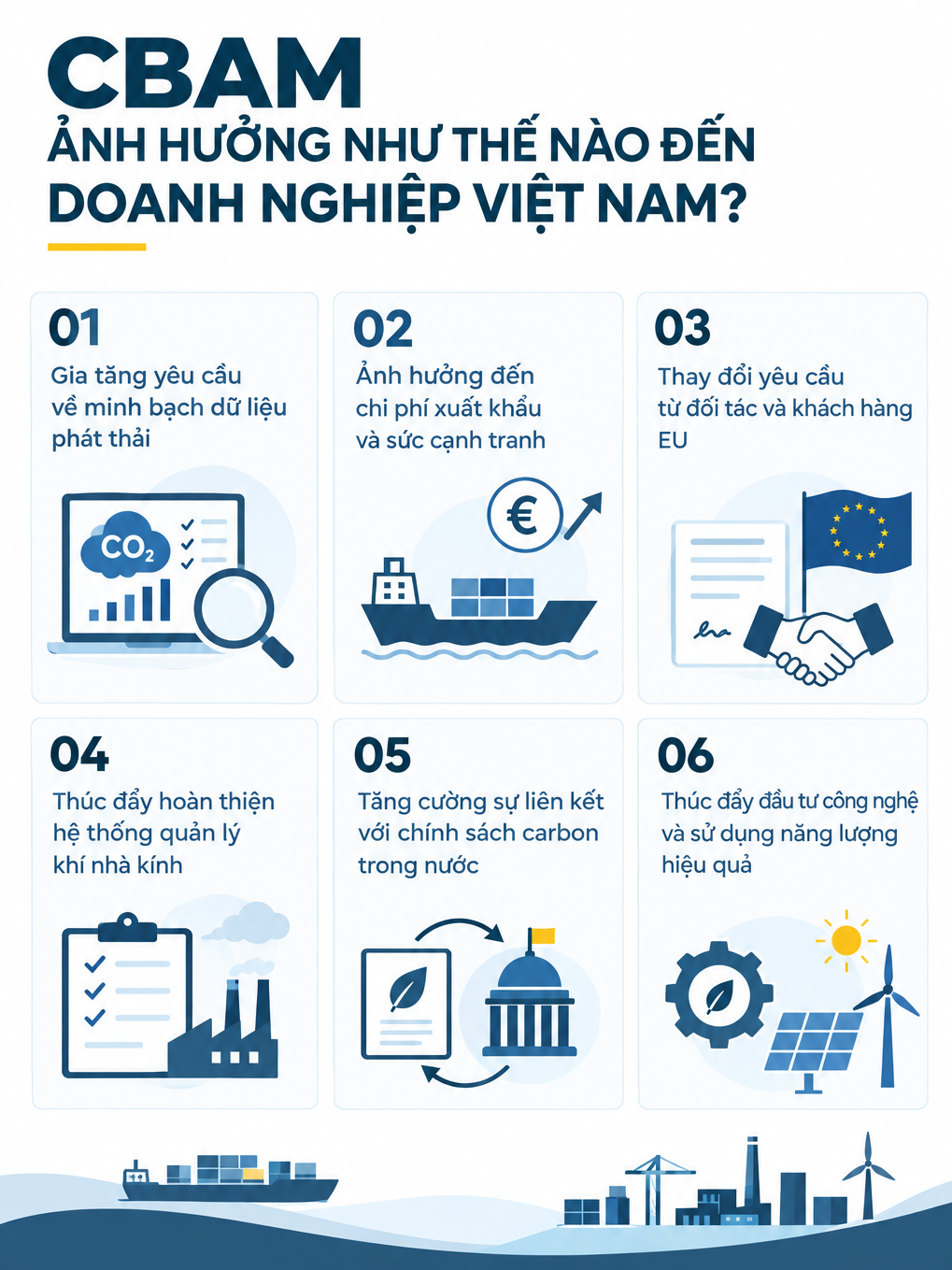
The impacts of CBAM on Vietnamese businesses.
The impact of CBAM is not limited to carbon costs but also relates to data requirements, manufacturing management, commercial contracts, and long-term investment orientation.
Increased demands for transparency in emissions data.
Businesses need to build systems for tracking, calculating, and storing emissions data at the product level. Providing complete, traceable information and meeting verification requirements becomes crucial in relationships with EU customers.
Impact on export costs and competitiveness
Goods with high emission intensity may entail greater CBAM certification obligations for importers. This could impact purchase prices, trade terms, and the competitiveness of Vietnamese products.
Conversely, businesses with transparent emissions data and good production efficiency will have more grounds to demonstrate the advantages of their products.
Changes in requirements from EU partners and customers.
Importers may add requirements regarding the provision of emission data, verification documents, calculation methods, and responsibility for updating information to the commercial contract.
Exporting businesses need to proactively coordinate with their partners to agree on data requirements and information exchange procedures.
Promoting the improvement of greenhouse gas management systems.
CBAM incentivizes businesses to standardize their emission measurement, reporting, and management practices, while also enhancing data control capabilities throughout the entire production process.
This also provides a basis for businesses to connect greenhouse gas inventory activities with environmental governance and sustainable development requirements.
Strengthening alignment with domestic carbon policies
The implementation of greenhouse gas inventory regulations and the development of a carbon market in Vietnam is helping businesses gradually improve their emission management capacity.
However, domestic carbon inventory data and obligations do not automatically replace the CBAM requirement. Businesses still need to comply with the calculation methodology and recognition conditions stipulated by the EU.
Promoting investment in technology and efficient energy use.
To adapt to CBAM, businesses can consider implementing solutions to improve equipment efficiency, optimize production processes, enhance energy management systems, and utilize low-emission energy sources.
These solutions not only help reduce product emission intensity but also contribute to optimizing operating costs and enhancing long-term competitiveness.
6. CBAM declaration process and CBAM certificate submission during the operational phase.
In the official phase starting in 2026, the CBAM declaration and certificate submission process will be carried out through the following main steps:
- Step 1 – Emission data collection: The manufacturing company provides information on the amount of emissions embedded in the goods and undergoes verification in accordance with EU regulations.
- Step 2 – CBAM Declaration: Authorized declarants in the EU compile emission data and import volumes to prepare an annual CBAM declaration.
- Step 3 – Determine the certificate obligation: Calculate the number of certificates to be submitted, taking into account adjustments to the EU ETS free quota and deductions for carbon prices already paid in the country of origin if conditions are met.
- Step 4 – Submission of CBAM certificates: Declarants in the EU purchase and submit the certificates in the required quantity and within the specified timeframe.
For Vietnamese businesses, proactively managing emission data, improving energy efficiency, and applying low-carbon production technologies will contribute to meeting CBAM requirements, reducing cost pressures, and maintaining a competitive advantage in the EU market.

7. Frequently Asked Questions about CBAM
7.1. Is CBAM a carbon tax?
CBAM is often referred to as a border carbon tax for convenience in interpretation. However, in legal terms, it is a mechanism for adjusting carbon costs through the obligation to purchase and submit CBAM certificates for imported goods within its scope of application.
7.2. Do Vietnamese businesses have to purchase CBAM certification?
Typically, the entity authorized to declare CBAM in the EU is the one responsible for purchasing and submitting the certificate.
Vietnamese businesses primarily provide emission information, production data, and related documents as requested by their partners. However, CBAM costs may be allocated indirectly through pricing and trade terms.
7.3. Does CBAM apply to all goods exported to the EU?
No. CBAM only applies to goods falling under the specified CN codes. The initial scope focused on six groups: iron and steel, aluminum, cement, fertilizers, hydrogen, and electricity, along with related products as specifically listed.
7.4. Can greenhouse gas inventory reports be used for CBAM?
Greenhouse gas inventories can provide a crucial data source for calculating CBAM emissions.
However, greenhouse gas inventories at the enterprise or facility level are not entirely equivalent to the method of determining emissions embedded in products. Therefore, businesses need to review their boundaries, emission sources, and attribution methods to meet the specific requirements of CBAM.
> See also: Reviewing the greenhouse gas inventory report
7.5. What preparations do businesses need to make to meet CBAM requirements?
Businesses should start by reviewing their export product catalogs, identifying CN codes that fall within the scope of CBAM, and assessing the current state of emission data.
Next, it is necessary to establish a system for collecting production data, calculating emissions embedded in products, preparing documentation for verification, and coordinating with EU partners in the declaration process.
In parallel, businesses should develop a roadmap for reducing emissions through technological improvements, energy management, and enhanced resource efficiency.
8. Proactively adapt to CBAM to enhance competitiveness.
Understanding what CBAM is, its scope of application, and the methods for determining emissions embedded in goods is a crucial first step for Vietnamese businesses participating in the export supply chain to the EU.
In the context of increasing emphasis on carbon emission control, businesses need to proactively build transparent data systems, enhance their capacity for greenhouse gas inventory, and implement energy-saving and efficient energy use solutions.
With nearly 20 years of experience in the energy and environment sector, VETS | EnE partners with businesses in improving emission management capabilities, optimizing energy use, and moving towards sustainable development.
Proactively preparing for CBAM requirements not only helps businesses adapt to EU trade and climate policies but also lays the foundation for improving production efficiency, meeting ESG standards, and moving towards the Net Zero target.
> See also: Greenhouse Gas Inventory Services


