
In the VTV1 special program “AI and the Climate Challenge,” Assoc. Prof. Dr. Duong Trung Kien – CEO of VETS | EnE – shared his professional analysis on the pressure of AI on the energy system, the environmental responsibility of technology corporations, and solutions to promote the parallel development of AI and the green energy transition.
This was also one of the important topics discussed at the 31st United Nations Climate Change Conference (COP31) in Antalya, Türkiye.
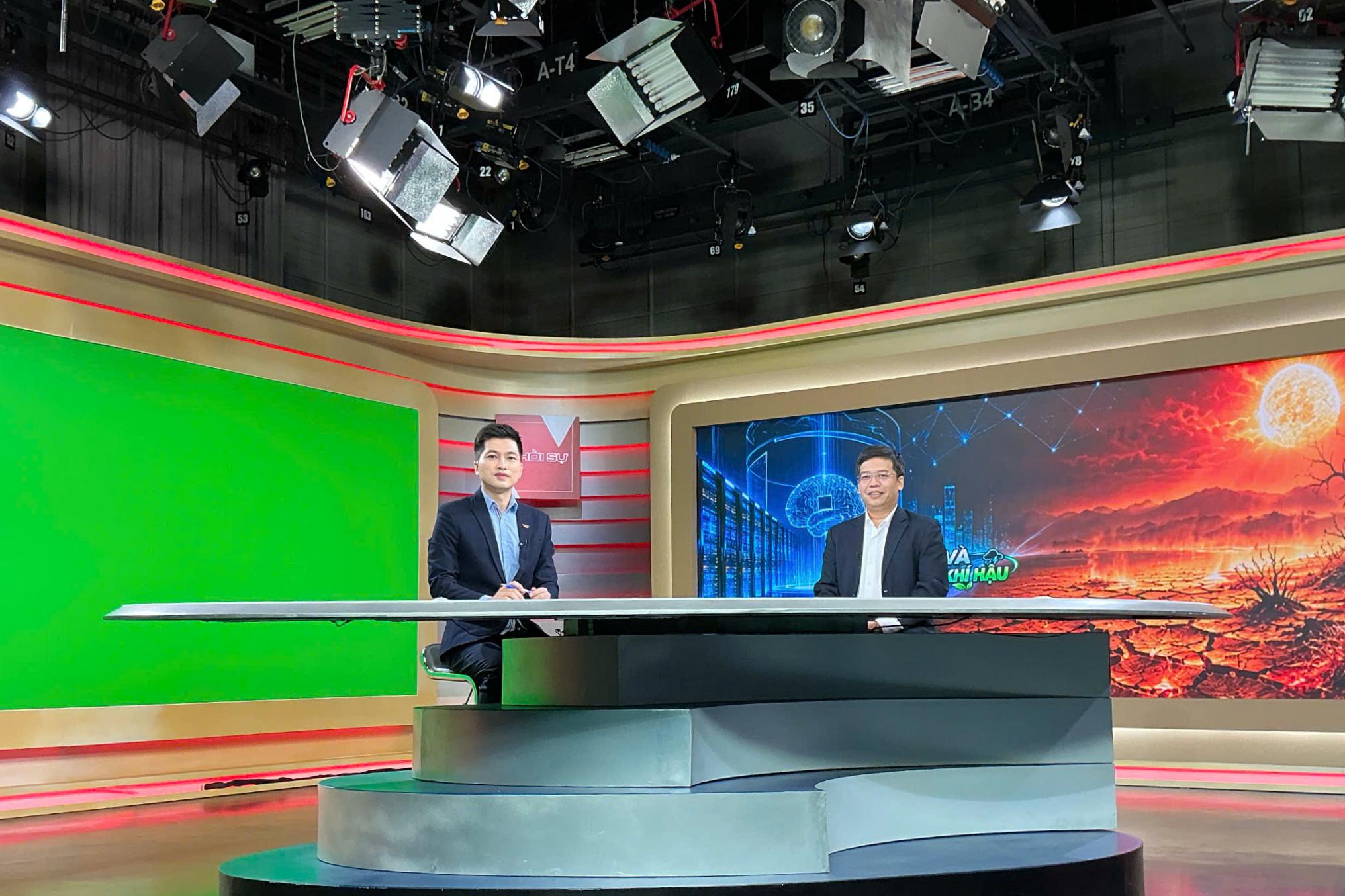
Professor Dr. Duong Trung Kien at the VTV1 studio, interviewing on the topic “AI and the climate challenge”.
The pressure of the AI wave on the environment.
Artificial intelligence is opening up significant opportunities in responding to climate change. Thanks to its ability to analyze and process large volumes of data, AI can support disaster forecasting, environmental monitoring, energy system optimization, and improved resource management efficiency.
However, behind those benefits lies a large-scale technological infrastructure, including data centers, servers, processors, and cooling systems. The rapid increase in demand for AI means increasingly greater consumption of electricity, water, and other resources.
According to data from the International Energy Agency (IEA), cited by the Public Opinion Newspaper, global data center electricity consumption increased by 17% in 2025, with data centers dedicated to AI increasing by as much as 50%. It is projected that by 2030, data center electricity demand could reach approximately 950 TWh, nearly double the 485 TWh of 2025.
Besides electricity, water resources are also under significant pressure. A report by the United Nations Institute for Water, Environment and Health (UNU-INWEH), cited in the article, forecasts that the amount of water related to data center operations could reach 9.3 trillion liters by 2030, while AI-related electronic waste could reach 2.5 million tons per year.
These figures show that the environmental impact of AI is not limited to electricity consumption during operation, but extends across the entire technology lifecycle, from resource extraction and equipment manufacturing to infrastructure construction and waste treatment.
The data center race and environmental pressures
Analyzing the challenges, Associate Professor Dr. Duong Trung Kien stated that the development of AI inevitably leads to an increasing demand for energy. As data processing and computing activities are transferred to AI systems, the amount of electricity required to operate servers, processors, and auxiliary equipment also increases accordingly.
According to him, this pressure manifests itself in three main aspects:
Firstly, the demand for electricity is increasing rapidly along with the scale of AI usage. Every AI application requires computing power from server systems. As the number of users and the volume of data processed increase, data centers must continuously expand their capacity, leading to greater electricity demand.
Secondly, energy consumption doesn’t just come from computing activities. Data centers also require air conditioning, ventilation, cooling, and other auxiliary equipment to maintain stable operating conditions. Therefore, energy efficiency assessments must consider the entire infrastructure rather than focusing solely on servers.
Third, the pace of AI development may outpace the energy system’s capacity to respond. While data centers can be built and expanded in a relatively short time, planning and investing in power plants and developing transmission and distribution infrastructure typically takes many years.
The trend of concentrating data centers in certain areas could put significant pressure on local power grids, requiring close coordination between digital infrastructure planning and energy development planning.
These analyses suggest that the development of AI needs to be considered in conjunction with electricity supply capacity, resource efficiency, and resulting environmental impacts, rather than solely based on data processing speed or the scale of technology investment.
Environmental responsibility in AI development
Sharing his views on this issue, Associate Professor Dr. Duong Trung Kien emphasized that technology corporations, as entities directly investing in, operating, and benefiting from AI, need to have a commensurate responsibility for resource utilization and the resulting environmental impacts.
According to him, this responsibility needs to be demonstrated in the following ways:
Transparency in resource consumption and emissions is crucial. Businesses need to publicly disclose data related to electricity and water usage and greenhouse gas emissions during operation. This provides a basis for regulatory bodies, society, and technology users to assess the actual environmental impact of AI.
Proactive investment in clean energy systems is crucial. Technology corporations should not only focus resources on computing infrastructure but also participate in investing in the development of wind power, solar power, energy storage systems, and energy infrastructure, contributing to meeting the growing electricity demand from their own technology activities.
Making energy efficiency a key criterion for technological development is crucial. Besides improving processing capacity, businesses need to focus on researching higher-performance microprocessors, algorithms, and operating systems, aiming to reduce energy consumption per unit of computational work.
According to Associate Professor Dr. Duong Trung Kien , the development of green AI requires technology companies to participate more deeply in the clean energy supply chain, while also linking environmental responsibility to long-term investment and operational strategies.
However, in addition to environmental challenges, AI is also an important tool for promoting the transition to green energy. Associate Professor Dr. Duong Trung Kien emphasized that technology and the environment need to develop in parallel, complementing each other rather than competing for resources.
While AI supports forecasting, monitoring, and optimizing energy system operations, the sustainable development of AI requires a stable, reliable, and increasingly green power supply. According to him, it is necessary to synchronize data center planning with the power system, while simultaneously improving mechanisms and policies to enhance energy efficiency and reduce emissions.
Towards a future of technology coupled with climate responsibility.
Based on green data center models implemented in several countries, Associate Professor Dr. Duong Trung Kien proposed priority directions to minimize the environmental impact of AI.

Associate Professor Dr. Duong Trung Kien proposed solutions to minimize the environmental impact of AI data centers.
First and foremost, it is necessary to improve energy efficiency in AI systems through advancements in microprocessor technology, optimization of algorithms, and reduction of energy consumption during data processing. This is not only an environmental requirement but can also create a competitive advantage for technology companies.
Next, it is necessary to promote the use of renewable energy combined with battery storage technology. Because data centers often operate continuously day and night, investing in green energy sources such as solar and wind power combined with battery storage systems will contribute to increasing the ability to utilize clean electricity and meet the needs for stable operation.
For countries with the potential to develop renewable energy like Vietnam, investing comprehensively in clean power sources and storage systems is crucial in the development of digital infrastructure.
Besides technological solutions, he also emphasized the need to improve the technical standards system, policy mechanisms on energy efficiency, and promote the direct electricity trading mechanism from renewable energy plants in Vietnam. These are crucial factors in improving management efficiency, encouraging the use of clean energy, and promoting the development of green and sustainable data centers.
Conclude
The rapid development of AI is opening up many opportunities for economic growth, innovation, and climate change response. However, these benefits can only be sustained when technological development is linked to efficient resource use, environmental responsibility, and emission reduction targets.
Through his expertise on AI and climate, Associate Professor Dr. Duong Trung Kien contributed to clarifying the relationship between digital transformation and energy transition, while emphasizing the role of energy management solutions, energy-saving technologies, and sustainable development mechanisms.
These directions are also consistent with VETS | EnE’s field of activity, aiming to promote energy and environmental services and solutions with real value, and to support businesses in their green transformation and sustainable development.


